Nvidia ConnectX-7 by numbers
Alexandre Cassen, <acassen@gmail.com> | Sebastien Hurtel, <sebastienhurtel@gmail.com>
This article picks up where the Nvidia Bluefield-3 by numbers benchmark left off. The DPU form factor gives an all-in-one box and a clean deployment story, but a lot of telco operators run their own gateway hardware and just want the NIC. We rerun the same protocol on a standalone ConnectX-7 sitting in a regular x86 chassis. The ConnectX-7 (CX7) is the chipset used by BF3. What changes is the host.
The main goal here is twofold. First, benchmark the CX7 itself
under the same protocol as the BF3. Second, use tc flower to push
the forwarding path into the NIC. That second part turned into
a new forwarding model inside fastSwan named flower-mode (aka
furious-mode). Building it also required some adaptations to the
mlx5 kernel driver, sent as an RFC patchset to the Nvidia Linux
kernel team.
The DUT runs on the following hardware:
- CPU: Intel(R) Xeon(R) Gold 6342 @ 2.80 GHz, 2 sockets × 24 cores (48 cores total, no SMT), Ice Lake-SP, 36 MB L3 per socket, PCIe Gen4 x16
- Memory: 125 GB DDR4, 2 NUMA nodes (NUMA 0: CPUs 0-23, NUMA 1: CPUs 24-47)
- NIC: NVIDIA ConnectX-7 HHHL adapter card, 200 GbE / NDR200 IB, dual-port QSFP112, PCIe Gen5.0 x16 with x16 PCIe extension option, Crypto and Secure Boot enabled
- Part Number: MCX755106AC-HEA_Ax
- PSID: MT_0000001045
- Firmware: 28.48.1000 (release date 11.2.2026)
- PCI location used for the bench: 0000:31:00.0 (p0) and 0000:31:00.1 (p1), NUMA node 0
- Kernel: Linux 7.0.10 PREEMPT_DYNAMIC, mlx5_core driver in NIC mode (legacy eswitch, no switchdev)
- Userland: strongSwan 6.0, fastSwan
Typical benchmark testrun
The video below is a live testrun of the XDP fib_lookup scenario.
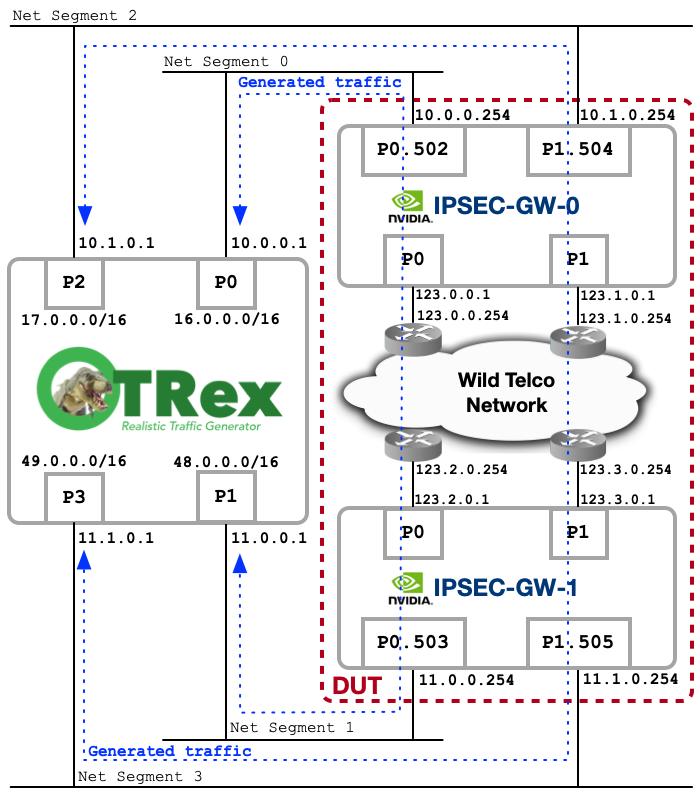
Network LAB topology
The lab is the same as Test 4 of the Bluefield-3 article. Each port of the DUT carries both clear-text traffic and the IPsec carrier on the same physical interface, where the clear-text side sits on an 802.1Q VLAN sub-interface and the IPsec ESP traffic rides the native untagged interface. That layout matches a wild telco edge.
System hardware and configuration
Three things matter for the host setup. CPU isolation keeps the
dataplane CPUs out of reach of the kernel scheduler, so the RX
queues never share their cycles with housekeeping work. NIC tuning
sets the RX rings, the RSS layout and the PCIe MaxReadReq to the
values that get the most out of the CX7 on this PCIe Gen4 platform.
fastSwan configuration enables flower-outbound-mode, flower-inbound-mode,
flower-decrement-ttl and route-to-nexthop on both physical
ports.
BOOT_IMAGE=/boot/vmlinuz-7.0.10 root=UUID=... ro
  intel_pstate=disable intel_iommu=on iommu=pt pci=realloc
  default_hugepagesz=1G hugepagesz=1G hugepages=32
  mitigations=off
  isolcpus=managed_irq,domain,4-23
  nohz_full=4-23 rcu_nocbs=4-23 rcu_nocb_poll
  irqaffinity=0-3 kthread_cpus=0-3
  intel_idle.max_cstate=1 processor.max_cstate=1
  cpufreq.default_governor=performance
  numa_balancing=disable transparent_hugepage=never
  skew_tick=1 nmi_watchdog=0 nosoftlockup
  clocksource=tsc tsc=reliable audit=0
#!/usr/bin/env bash
# CPU layout, NUMA 0 only (Package 0, CPUs 0-23):
#   0-1     housekeeping (kernel, generic IRQs, services)
#   2-3     fastSwan daemon + monitor pthread
#   4-13    p0 (mlx5_0, PCI 0000:31:00.0) rx queues 0..9
#   14-23   p1 (mlx5_1, PCI 0000:31:00.1) rx queues 0..9

P0_IFACE=p0
P1_IFACE=p1
RXQ_COUNT=10
P0_PCI=0000:31:00.0
P1_PCI=0000:31:00.1
P0_RXQ_CPUS=4-13
P1_RXQ_CPUS=14-23

log() {
        printf '[setup-host] %s\n' "$*"
}

expand_cpulist() {
        local IFS=,
        for part in $1; do
                if [[ $part == *-* ]]; then
                        seq "${part%-*}" "${part#*-}"
                else
                        echo "$part"
                fi
        done
}

disable_thp() {
    log "disable transparent hugepages"
    local f
    for f in /sys/kernel/mm/transparent_hugepage/enabled \
         /sys/kernel/mm/transparent_hugepage/defrag; do
        [ -w "$f" ] && echo never > "$f"
    done
}

sysctl_tune() {
    log "apply sysctl tuning"
    sysctl -qw kernel.nmi_watchdog=0
    sysctl -qw net.core.bpf_jit_enable=1
    sysctl -qw net.core.bpf_jit_harden=0
    sysctl -qw net.ipv4.ip_forward=1
    sysctl -qw net.ipv6.conf.all.forwarding=1
    sysctl -qw net.ipv4.conf.all.rp_filter=0
    sysctl -qw net.ipv4.conf.default.rp_filter=0
    sysctl -qw net.core.busy_poll=50
    sysctl -qw net.core.busy_read=50
    sysctl -qw net.core.netdev_budget=600
    sysctl -qw net.core.netdev_budget_usecs=8000
}

tune_nic() {
        local dev=$1

        log "tune $dev"

        ethtool -K "$dev" gro off lro off gso off tso off
        ethtool -K "$dev" hw-tc-offload on ntuple on
        ethtool -G "$dev" rx 8192 tx 8192
        ethtool -C "$dev" adaptive-rx off adaptive-tx off
        ethtool -C "$dev" rx-usecs 8 rx-frames 64 tx-usecs 8
        ethtool -A "$dev" rx off tx off 2>/dev/null || true
        ethtool --set-priv-flags "$dev" rx_striding_rq on
        ethtool --set-priv-flags "$dev" rx_cqe_compress on
        ethtool -L "$dev" combined "$RXQ_COUNT"
        ethtool -X "$dev" equal "$RXQ_COUNT"
        ip link set "$dev" up
}

# Pin mlx5_compN IRQs by name from /proc/interrupts in queue order
pin_mlx_rxqs() {
        local pci=$1
        local cpulist=$2
        local cpus
        cpus=( $(expand_cpulist "$cpulist") )

        local q irq cpu pat
        for ((q = 0; q < RXQ_COUNT; q++)); do
                pat="mlx5_comp${q}@pci:${pci}"
                irq=$(awk -v p="$pat" \
                        '$NF == p { sub(":","",$1); print $1 }' \
                        /proc/interrupts)
                if [ -z "$irq" ]; then
                        log "pin: $pci comp$q IRQ not found"
                        continue
                fi
                cpu=${cpus[$q]}
                log "pin: $pci comp$q (IRQ $irq) -> CPU $cpu"
                echo "$cpu" > "/proc/irq/$irq/smp_affinity_list"
        done
}

# Bump PCIe MaxReadReq to 2048B
set_pcie_mrrs() {
        local pci=$1
        local cur new
        cur=$(setpci -s "$pci" CAP_EXP+8.w)
        new=$(printf '%04x' $(( (0x$cur & 0x8fff) | 0x4000 )))
        setpci -s "$pci" CAP_EXP+8.w=$new
        log "pcie: $pci DevCtl 0x$cur -> 0x$new (MRRS=2048B)"
}

disable_thp
sysctl_tune
tune_nic "$P0_IFACE"
tune_nic "$P1_IFACE"
set_pcie_mrrs "$P0_PCI"
set_pcie_mrrs "$P1_PCI"
pin_mlx_rxqs "$P0_PCI" "$P0_RXQ_CPUS"
pin_mlx_rxqs "$P1_PCI" "$P1_RXQ_CPUS"
log "done"
# Inspect current values
mlxconfig -d 0000:31:00.0 -e q
mlxconfig -d 0000:31:00.1 -e q

# Move hairpin data buffers into HCA SRAM
mlxconfig -d 0000:31:00.0 set HAIRPIN_DATA_BUFFER_LOCK=True
mlxconfig -d 0000:31:00.1 set HAIRPIN_DATA_BUFFER_LOCK=True

# Enable the flex parser profile needed by the IPsec accel path
mlxconfig -d 0000:31:00.0 set FLEX_PARSER_PROFILE_ENABLE=3
mlxconfig -d 0000:31:00.1 set FLEX_PARSER_PROFILE_ENABLE=3

# Apply the new config without a full reboot
mlxfwreset -d 0000:31:00.0 -y reset
mlxfwreset -d 0000:31:00.1 -y reset
ip link set p0 up
ip link add link p0 name p0.502 type vlan id 502
ip link set dev p0.502 up
ip a a 123.0.0.1/16 dev p0
ip a a 10.0.0.254/24 dev p0.502

ip link set p1 up
ip link add link p1 name p1.504 type vlan id 504
ip link set dev p1.504 up
ip a a 123.1.0.1/16 dev p1
ip a a 10.1.0.254/24 dev p1.504

ip r a 123.2.0.0/16 via 123.0.0.254
ip r a 123.3.0.0/16 via 123.1.0.254
ip r a 16.0.0.0/8   via 10.0.0.1
ip r a 17.0.0.0/8   via 10.1.0.1
ip r a 48.0.0.0/8   via 123.0.0.254
ip r a 49.0.0.0/8   via 123.1.0.254
hostname fastSwan
!
daemon-cpu 2-3
daemon-priority 50
lock-memory
cpu-mask 0-23
!
bpf-program xdp-xfrm
 path /etc/fastswan/xfrm_offload.bpf
 no shutdown
!
interface p0
 bpf-program xdp-xfrm
 hairpin-to-nexthop 10.0.0.1
 flower-inbound-mode
 flower-outbound-mode
 flower-decrement-ttl
 no shutdown
!
interface p0.502
 no shutdown
!
interface p1
 bpf-program xdp-xfrm
 hairpin-to-nexthop 10.1.0.1
 flower-inbound-mode
 flower-outbound-mode
 flower-decrement-ttl
 no shutdown
!
interface p1.504
 no shutdown
!
load-existing-xfrm-policy
!
line vty
 no login
 listen unix owner fswan group fswan
!
ip link set p0 up
ip link add link p0 name p0.503 type vlan id 503
ip link set dev p0.503 up
ip a a 123.2.0.1/16 dev p0
ip a a 11.0.0.254/24 dev p0.503

ip link set p1 up
ip link add link p1 name p1.505 type vlan id 505
ip link set dev p1.505 up
ip a a 123.3.0.1/16 dev p1
ip a a 11.1.0.254/24 dev p1.505

ip r a 123.0.0.0/16 via 123.2.0.254
ip r a 123.1.0.0/16 via 123.3.0.254
ip r a 16.0.0.0/8   via 123.2.0.254
ip r a 17.0.0.0/8   via 123.3.0.254
ip r a 48.0.0.0/8   via 11.0.0.1
ip r a 49.0.0.0/8   via 11.1.0.1
hostname fastSwan
!
daemon-cpu 2-3
daemon-priority 50
lock-memory
cpu-mask 0-23
!
bpf-program xdp-xfrm
 path /etc/fastswan/xfrm_offload.bpf
 no shutdown
!
interface p0
 bpf-program xdp-xfrm
 hairpin-to-nexthop 11.0.0.1
 flower-inbound-mode
 flower-outbound-mode
 flower-decrement-ttl
 no shutdown
!
interface p0.503
 no shutdown
!
interface p1
 bpf-program xdp-xfrm
 hairpin-to-nexthop 11.1.0.1
 flower-inbound-mode
 flower-outbound-mode
 flower-decrement-ttl
 no shutdown
!
interface p1.505
 no shutdown
!
load-existing-xfrm-policy
!
line vty
 no login
 listen unix owner fswan group fswan
!
The kernel cmdline isolates CPUs 4-23 (isolcpus, nohz_full,
rcu_nocbs, irqaffinity=0-3) and clamps C-states at C1, so the
RX queues never lose cycles to housekeeping or deep idle. The
governor stays at performance and mitigations are off so the
absolute numbers do not get muddied by speculative-exec fences.
setup-host.sh disables transparent hugepages, turns off the
GRO/LRO/GSO/TSO offloads we do not want in front of XDP, enables
hw-tc-offload, lays out 10 RX queues per port, pins
each mlx5_compN IRQ on its dedicated CPU, and finally bumps the
PCIe MaxReadReq from 512 to 2048 bytes (DevCtl[14:12]). That
last bit buys roughly 6 Gbps per direction without exploding the
rx_out_of_buffer rate.
fastswan.conf declares one XDP program and binds it on p0 and p1,
then enables flower-inbound-mode, flower-outbound-mode and
flower-decrement-ttl on each. hairpin-to-nexthop pre-resolves the
LAN-side next hop once at warmup so the data path skips the kernel
FIB lookup, and load-existing-xfrm-policy replays the strongSwan
SAs at boot.
The mlxconfig tweaks move the hairpin data buffers into HCA SRAM
(HAIRPIN_DATA_BUFFER_LOCK=True) so cross-NIC hairpin traffic stays
off PCIe, and switch the flex parser to profile 3 so the IPsec accel
path lights up.
Once fastSwan is running, two VTY commands confirm the host layout
landed as planned. show interface topology walks the PCI tree and
shows the NUMA placement and driver for each ethernet device:
fastSwan> show interface topology
PCI ethernet topology
├── NUMA node 0
│   ├── 0000:31:00.0
│   │   ├── vendor: Mellanox Technologies [15b3]
│   │   ├── model:  MT2910 Family [ConnectX-7] [1021]
│   │   ├── driver: mlx5_core
│   │   └── net:    p0
│   ├── 0000:31:00.1
│   │   ├── vendor: Mellanox Technologies [15b3]
│   │   ├── model:  MT2910 Family [ConnectX-7] [1021]
│   │   ├── driver: mlx5_core
│   │   └── net:    p1
│   ├── 0000:4b:00.0
│   │   ├── vendor: Intel Corporation [8086]
│   │   ├── model:  I350 Gigabit Network Connection [1521]
│   │   ├── driver: igb
│   │   └── net:    enp75s0f0
│   └── 0000:4b:00.1
│       ├── vendor: Intel Corporation [8086]
│       ├── model:  I350 Gigabit Network Connection [1521]
│       ├── driver: igb
│       └── net:    enp75s0f1
└── NUMA node 1
    ├── 0000:b1:00.0
    │   ├── vendor: Mellanox Technologies [15b3]
    │   ├── model:  MT2910 Family [ConnectX-7] [1021]
    │   ├── driver: mlx5_core
    │   └── net:    p2
    └── 0000:b1:00.1
        ├── vendor: Mellanox Technologies [15b3]
        ├── model:  MT2910 Family [ConnectX-7] [1021]
        ├── driver: mlx5_core
        └── net:    p3
show interface rx-queue topology reports per-queue IRQ and CPU
pinning:
fastSwan> show interface rx-queue topology
 NUMA node 0  [cpus: 0-23  24 CPUs]
   p0  rx_queues:10
     rx-0   irq:169    cpu:4
     rx-1   irq:176    cpu:5
     rx-2   irq:177    cpu:6
     rx-3   irq:178    cpu:7
     rx-4   irq:179    cpu:8
     rx-5   irq:180    cpu:9
     rx-6   irq:181    cpu:10
     rx-7   irq:182    cpu:11
     rx-8   irq:183    cpu:12
     rx-9   irq:184    cpu:13
   p0.502  rx_queues:0
   p1  rx_queues:10
     rx-0   irq:171    cpu:14
     rx-1   irq:223    cpu:15
     rx-2   irq:224    cpu:16
     rx-3   irq:225    cpu:17
     rx-4   irq:226    cpu:18
     rx-5   irq:227    cpu:19
     rx-6   irq:228    cpu:20
     rx-7   irq:229    cpu:21
     rx-8   irq:230    cpu:22
     rx-9   irq:231    cpu:23
   p1.504  rx_queues:0

Diagnostic:
  [ OK ] p0: pinning and NUMA locality correct
  [ OK ] p1: pinning and NUMA locality correct
  [ OK ] all rx queue IRQs use distinct CPUs

  Overall: rx queue affinity configuration is optimal
To not warm the house, use the Flower!
XDP, AF_XDP, DPDK, PF_RING, VPP, they all push impressive packet rates, and they all burn host CPU on every packet. At 100 Gbps with a realistic iMIX, that is wattage out the back of the rack no matter which framework draws the box. And every watt the CPU draws is another watt the HVAC has to pull back out of the room.
tc flower with skip_sw flips the model. Instead of catching the
packet in software and asking the NIC nicely to send it back out,
the rule lands inside the NIC's flow-steering pipeline. The
hardware matches the packet against the rule on ingress, runs the
action chain (pedit, vlan push, mirred), and forwards through an
internal SQ-to-RQ "hairpin" pair to the egress port. Nothing
crosses the PCIe boundary into the host, the driver never wakes.
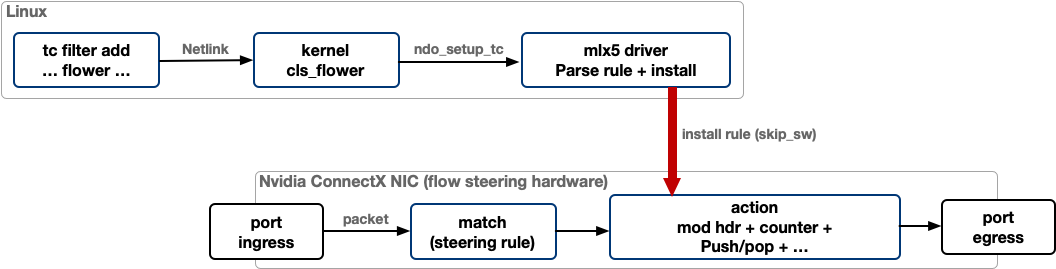
Nvidia describes this flow from the firmware side in their
IPsec full offload documentation. The supported path there is
the eswitch model, where the device is flipped into switchdev mode
and the FDB carries both IPsec packet offload and the flower rule.
That path is the architectural fit because the FDB has native
vlan_push, native vport-to-vport forwarding, and lives downstream
of the IPsec accel table on RX.
Unfortunately, the CX7 PSID we are using here does not support IPsec packet offload in switchdev mode. Trying to enable it via devlink is firmware-refused:
# devlink port function set pci/0000:31:00.0/1 ipsec_packet enable
Error: mlx5_core: Device doesn't support IPsec packet mode.
kernel answers: Operation not supported
In NIC mode both IPsec and flower are supported but the stock mlx5 driver still refuses to run IPsec packet offload and tc flower on the same netdev, and the inbound path needs an extra capability the driver does not expose. We worked on the mlx5 driver to lift both limitations, so that IPsec and flower coexist on the same NIC and the inbound direction can run entirely in hardware.
Two videos show the end result in motion. The XDP-Hairpin run is the reference, where every packet still climbs the XDP stack and the per-queue CPU graph fills the screen. The Flower-Hairpin run is the same load with flower on both directions, where the per-CPU graph stays flat at zero and latency drops because the host is no longer the bottleneck.
IPsec tunnel mode in switchdev
The switchdev refusal above is the bare enable. With dmfs steering
and encap-mode none set on the eswitch first, the firmware does
enable ipsec_packet on a VF and offloads transport mode. It
still refuses tunnel mode at SA install. This probe runs on the
Nvidia-validated DOCA-OFED stack (Ubuntu 24.04, kernel 6.8, same
28.48.1000 firmware), so it is not a custom-kernel artifact.
The full reproduction setup follows, split into the eswitch enable, the clear-text network, the tc-flower hairpin, the strongSwan isolation on the VF netdev, and the swanctl config it loads:
echo 1 > /sys/class/net/p0/device/sriov_numvfs
devlink dev param set pci/0000:31:00.0 \
    name flow_steering_mode value dmfs cmode runtime
devlink dev eswitch set pci/0000:31:00.0 encap-mode none
devlink dev eswitch set pci/0000:31:00.0 mode switchdev

# the VF must be unbound before ipsec_packet is enabled
echo 0000:31:00.2 > /sys/bus/pci/drivers/mlx5_core/unbind
devlink port function set pci/0000:31:00.0/1 ipsec_packet enable
echo 0000:31:00.2 > /sys/bus/pci/drivers/mlx5_core/bind
ip link set p0 up
ip link set ens1f0r0 up
ip link add link p0 name p0.502 type vlan id 502
ip link set dev p0.502 up
ip a a 10.0.0.254/24 dev p0.502
ip r a 16.0.0.0/8 via 10.0.0.1
tc qdisc add dev p0 ingress
tc qdisc add dev ens1f0r0 ingress
tc filter add dev p0 parent ffff: protocol all chain 0 flower \
    action mirred egress redirect dev ens1f0r0
tc filter add dev ens1f0r0 parent ffff: protocol all chain 0 flower \
    action mirred egress redirect dev p0
# strongSwan must run on the VF in its own netns or a VM so IKE
# binds to the isolated VF netdev
ip netns add vf0
ip link set ens1f0v0 netns vf0
ip -n vf0 link set lo up
ip -n vf0 link set ens1f0v0 up
ip -n vf0 a a 123.0.0.1/16 dev ens1f0v0
ip -n vf0 r a 123.2.0.0/16 via 123.0.0.254
ip -n vf0 r a 48.0.0.0/8 via 123.0.0.254

ip netns exec vf0 ipsec start
ip netns exec vf0 swanctl --load-all
ip netns exec vf0 swanctl -i --child gw
connections {
  B-TO-B {
    local_addrs  = 123.0.0.1
    remote_addrs = 123.2.0.1

    local {
        auth = psk
        id = ipsec-gw
    }
    remote {
        auth = psk
        id = ipsec-enodeb
    }

    children {
      gw {
        local_ts = 16.0.0.0/16
        remote_ts = 48.0.0.0/16
        mode = tunnel
        policies_fwd_out = yes

        #   Transport mode configuration
        #local_ts = 123.0.0.1/32
        #remote_ts = 123.2.0.1/32
        #mode = transport

        esp_proposals = aes128gcm128-x25519-esn
        hw_offload = packet
      }
    }
    version = 2
    mobike = no
    reauth_time = 0
    proposals = aes128-sha256-x25519
  }
}

secrets {
  ike-GW {
    id-1 = ipsec-gw
    id-2 = ipsec-enodeb
    secret = 'TopSecret'
  }
}
With mode = tunnel and hw_offload = packet on the child, IKE
completes, then the outbound SA install is firmware-refused:
[KNL] received netlink error: mlx5_core: Device failed to offload this state (22)
[KNL] unable to add SAD entry with SPI c7925e3c (FAILED)
[IKE] unable to install outbound IPsec SA (SAD) in kernel
dmesg carries the matching firmware syndrome:
mlx5_core 0000:31:00.2: SET_FLOW_TABLE_ENTRY(0x936) op_mod(0x0) failed, status bad parameter(0x3), syndrome (0x65c1fb), err(-22)
mlx5_core 0000:31:00.2: tx_add_rule:2231: fail to add TX ipsec rule err=-22
The identical setup with mode = transport establishes the
CHILD_SA with no error.
A VF is not the uplink representor, so ipsec_tx() routes the SA
to the NIC EGRESS_IPSEC table, the same one a legacy PF uses, and
the driver builds a byte-identical request. The tunnel reformat
clears the driver gate because mlx5_eswitch_block_encap()
short-circuits for a VF and reports the reformat allowed without
ever claiming the PF eswitch encap engine that owns it. The
firmware then refuses the uncoordinated VF-egress
L2_TO_L3_ESP_TUNNEL reformat under switchdev arbitration, which
is the 0x65c1fb syndrome. Transport mode escapes the contention
because ADD_ESP_TRANSPORT is a separate engine, and legacy PF
escapes it because no eswitch owns the engine, so the firmware
hands it to the IPsec table.
The HW can build the reformat, since legacy mode works... What blocks tunnel mode is that switchdev places the encap engine under eswitch arbitration, and this PSID's firmware will not release it to a VF-egress IPsec tunnel rule. The solution seems to be a firmware that implements the VF-egress tunnel reformat.
Test scenarios
The bench compares four incremental configurations, all built on top of CX7 IPsec packet offload. What changes is where the forwarding work runs around the crypto.
The first scenario, XDP fib_lookup, is the all-software baseline
on the host side. The XDP program does the LPM match, then a
bpf_xdp_fib_lookup to find the next hop, then writes the
ethernet header and submits an XDP_TX. The FIB lookup is the
single most expensive step. Every packet does the full route walk
inside the eBPF program.
The second scenario, XDP Hairpin, swaps the per-packet FIB
lookup for a warmup-time resolution. fastSwan resolves the
configured hairpin-to-nexthop once when the LAN-side neighbour
appears, caches the next-hop MAC and the egress ifindex in a BPF
map, and the XDP fast path reads from the cache instead of walking
the FIB.
The third scenario, XDP Hairpin + outbound flower, lifts the
outbound forwarding into the NIC through tc flower with skip_sw,
while inbound stays on XDP with the hairpin cache. Outbound
established flows never reach XDP, since the hardware catches the
clear-text VLAN ingress, decrements the TTL with pedit ttl dec,
and mirreds straight into the IPsec encrypt table. The XDP program
still carries the inbound direction.
The fourth scenario, Flower, completes the move and lifts the
inbound side as well. Both directions install with skip_sw,
both sit on the NIC steering tables (chain 0 on outbound,
post-decrypt chain on inbound), and the host CPUs see nothing
beyond housekeeping ticks. This is the regime the patchset
unlocks.
TRex profiles
Three profiles drive the bench, all symmetric in both directions.
ipsec-cx7.py: six-bucket IMIX tuned for the maximum wire-side pps. Measured peak per port: 19.35 Mpps / 97 Gbps. Way more than any realistic mobile-edge deployment, used as the absolute upper bound to find where the wire actually ends.MNO-traffic-pattern.py: 5G-shaped iMIX from the BF3 article, 162k pps per port at base rate (4G + 5G buckets combined). Measured peak per port after TRex amplification: 11.25 Mpps / 98.2 Gbps. The headline profile used to sweep the 1k to 1.6k IPsec tunnel range.MNO-mixed-symmetric.py: stacks the 4G/clients and 4G/cmg iMIXes on every port in both directions, 232k pps per port at base rate. Measured peak per port after TRex amplification: 14 Mpps / 98 Gbps. Used for stress runs.
Flamegraph analysis
The four scenarios were captured with perf while the
MNO-traffic-pattern profile was driving the bench. The first
three captures target the dataplane CPUs (2-19) directly. The
fourth, the full-flower run, is a system-wide capture because the
dataplane CPUs sit in mwait for almost the entire window and a
dataplane-only capture would have no samples. Read the fourth one
in proportions, not in absolute cycles.
The CPUs that run the dataplane sit in swapper/do_idle whenever
they are not processing a packet, so the all frame in each SVG
is dominated by the idle path. Two numbers carry the real signal,
the total cycle count of the capture, and the cycles charged to
handle_softirqs. The first tells how often the CPU was awake at
all, the second is the actual RX and forwarding work.
| metric | baseline (XDP-only) | + hairpin | + hairpin + flower |
|---|---|---|---|
| total CPU cycles | 1759 G (100 %) | 1619 G (92 %) | 1197 G (68 %) |
| softirq work cycles | 1390 G (100 %) | 1230 G (89 %) | 742 G (53 %) |
mwait idle share |
86.3 % | 84.0 % | 75.1 % |
net_rx_action share |
78.9 % | 75.8 % | 61.8 % |
Going from the baseline to hairpin removes about 12 % of the
forwarding cycles, since the bpf_xdp_fib_lookup subtree
disappears outright. The functions fib_table_lookup,
fib_lookup_good_nhc, __ipv4_neigh_lookup_noref,
find_exception, ip_mtu_from_fib_result and ip_ignore_linkdown
are present in the baseline and absent from both offload graphs.
The warmup rule that pins the next hop pays for itself
immediately because every packet then skips the kernel FIB. The
LPM share rises slightly because the denominator shrank, yet the
absolute cycles in trie_lookup_elem fall.
Adding the outbound flower brings the saving to 47 %. With
skip_sw installed on the clear-text ingress, the established
flows never reach XDP and the user eBPF program runs only for the
inbound direction and the exception traffic. The user prog
collapses from 547 G to 212 G cycles and the LPM lookup follows
because fewer packets reach that stage. The relative growth of
mlx5e_xmit_xdp_frame_mpwqe from 24 % to 38 % is a denominator
effect, since the warmup and inbound XDP_TX still go through XDP
and are now a larger fraction of a much smaller pie.
The full-flower capture is the regime change. Both directions
run with skip_sw and the NIC catches every matching frame at
ingress, so the mlx5 driver never delivers the packet to the host.
| function (share of total) | full flower |
|---|---|
swapper (all idle threads) |
73.7 % |
intel_idle_irq (sum of stacks) |
35.1 % |
handle_softirqs (top frame) |
10.8 % |
run_timer_softirq (under softirq) |
10.6 % |
rcuog/0 kthread |
3.7 % |
fastswan user process (control plane) |
6.3 % |
mlx5e_xmit |
0.01 % |
What carries the message is what is missing. The softirq pie
collapses to timer ticks, since run_timer_softirq covers
almost the entire handle_softirqs frame. The fastswan
cycles are control-plane work like cmd_exec and
entry_match_by_sa, not packet forwarding.
1k IPsec tunnels: fib_lookup, XDP Hairpin and Flower
The first run sets three models side by side at 1k tunnels, 500 per port with traffic both directions. The fourth config, XDP Hairpin plus outbound flower, stays in the flamegraph analysis where it shows on CPU, not the wire. It asks what hairpinning buys over a FIB lookup, and what flower changes once the host leaves the path.
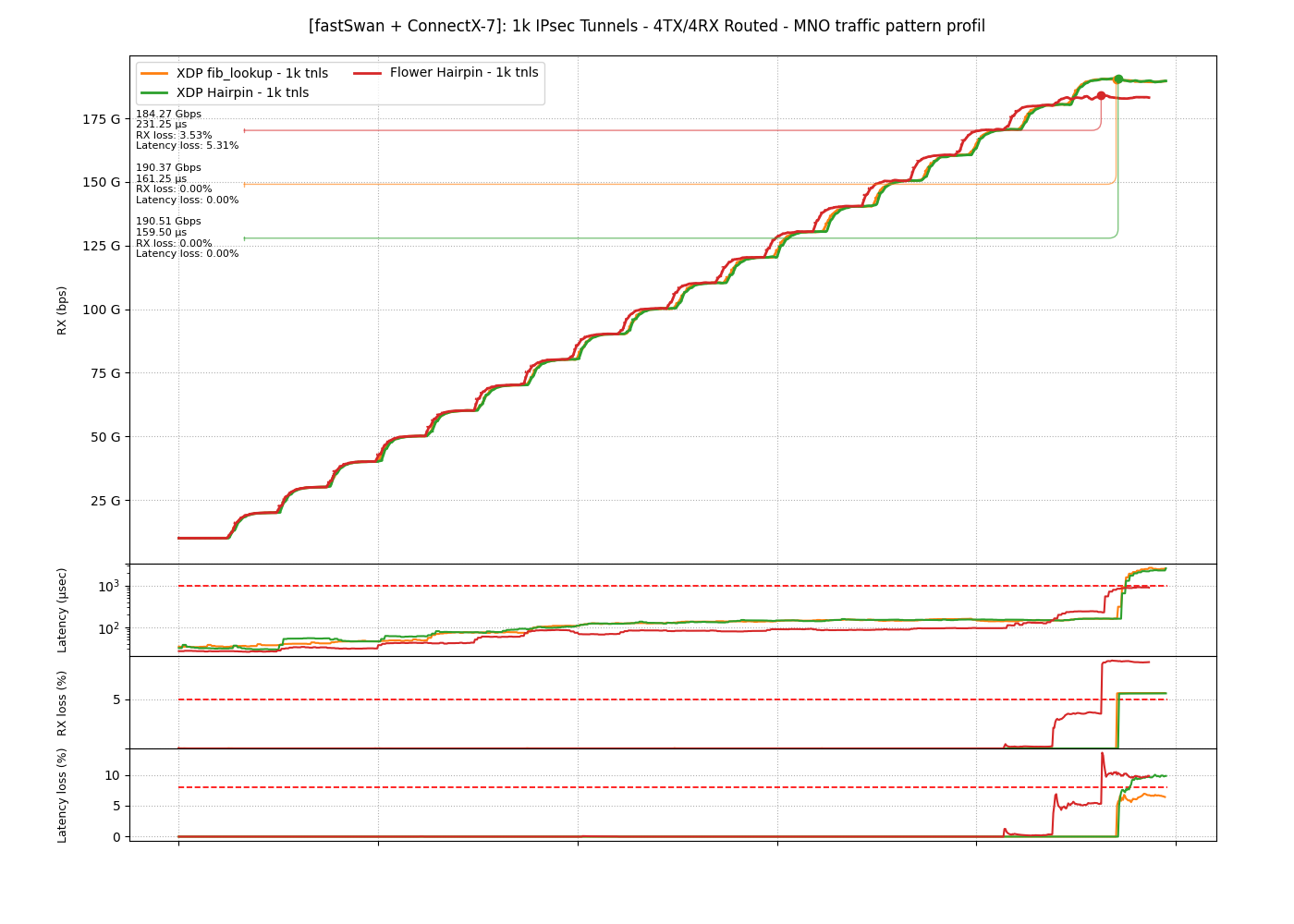
Throughput here is the TRex aggregate over the two ports p0 and p1, loaded equally, so the per-port rate is half. The two XDP variants land together at 190.5 Gbps with no loss, so the warmup cache costs nothing over the per-packet FIB walk. Flower holds 184.3 Gbps before it drops frames, just under the pair, and its latency runs lower in the clean region, near 100 µs against 150 µs, though it spikes to the 231 µs at 3.53 % loss once it saturates. Flower trades a little peak bandwidth for steadier, lower latency, the whole point on a mobile edge.
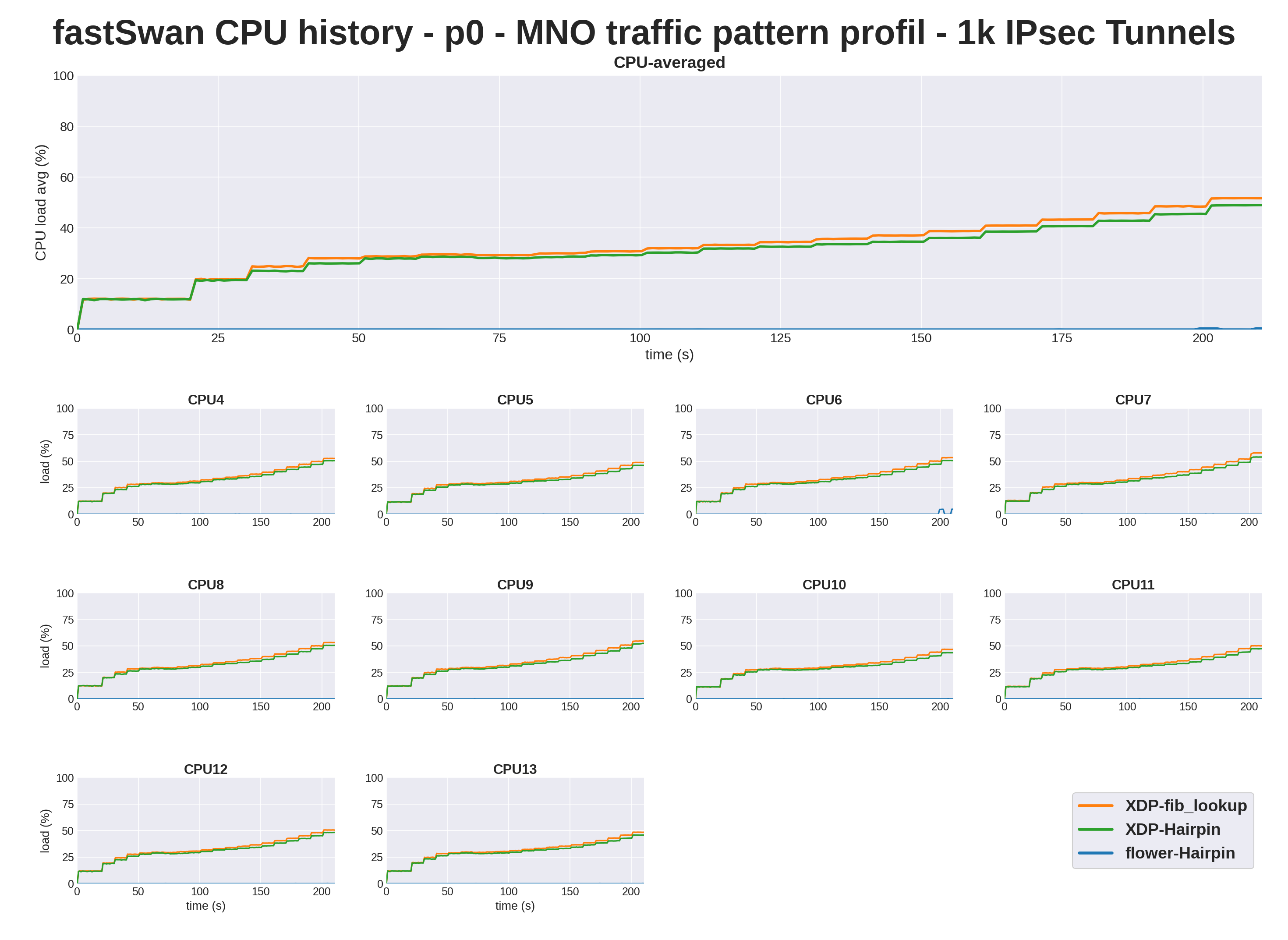
On CPU, XDP Hairpin tracks just under fib_lookup, so the cache trims a small but real slice of cycles. The line that matters is the flat one, flower runs the established flows in the NIC and the dataplane CPUs stay at 0 %.
From here the bench keeps only XDP Hairpin and Flower. fib_lookup was just a reference, since the gain comes from hairpinning, not from where the route lookup runs.
XDP Hairpin under tunnel scaling
This run sweeps the tunnel count from 1k to 1.6k on the XDP Hairpin model and reads both the wire and the host.
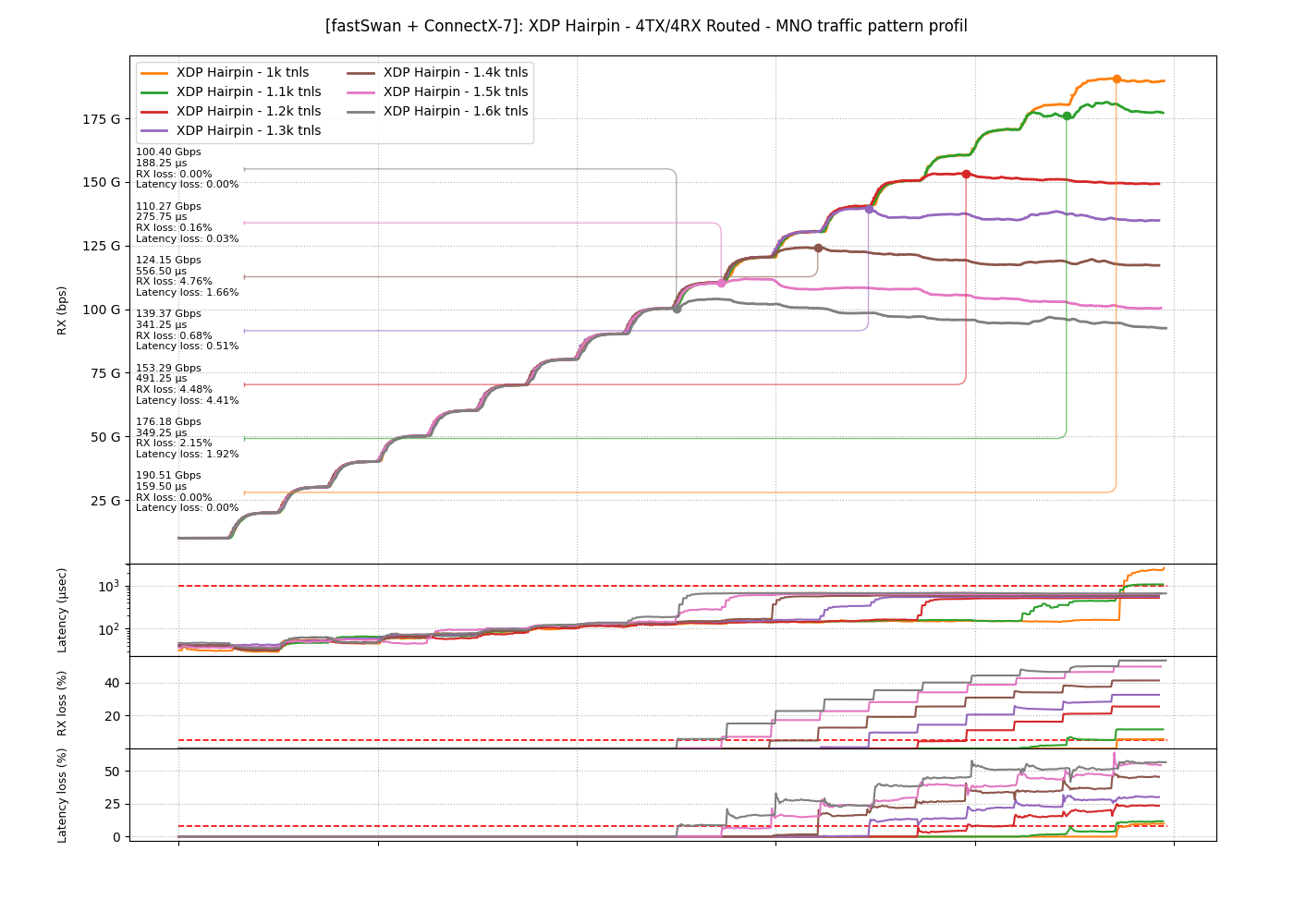
The maximum clean bandwidth falls as the tunnel count climbs, from 190.5 Gbps at 1k down to 100.4 Gbps at 1.6k. The decline stays close to linear, near 150 Gbps lost for every extra 1k tunnels.
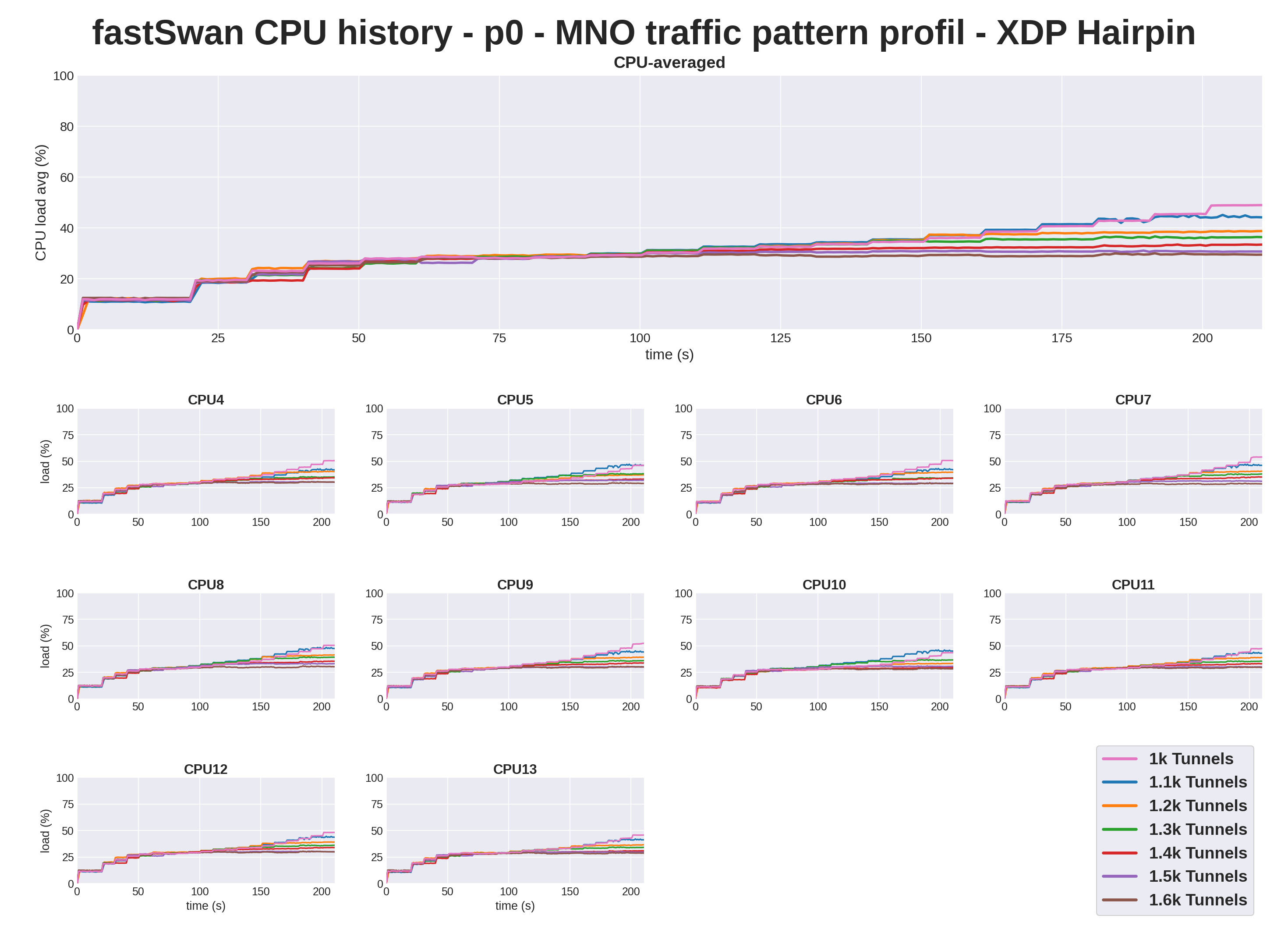
The host CPU moves the other way and drops as tunnels grow. That reads backward until you put it next to the wire, since less traffic gets through at high tunnel counts, so the CPUs have less to forward. The host is no longer the limit, the NIC and the PCIe path are, which is the signature of a hardware bottleneck.
Flower Hairpin under tunnel scaling
The same sweep on Flower Hairpin keeps only the TRex side, because the host CPU stays flat at zero across every tunnel count and adds nothing to read.
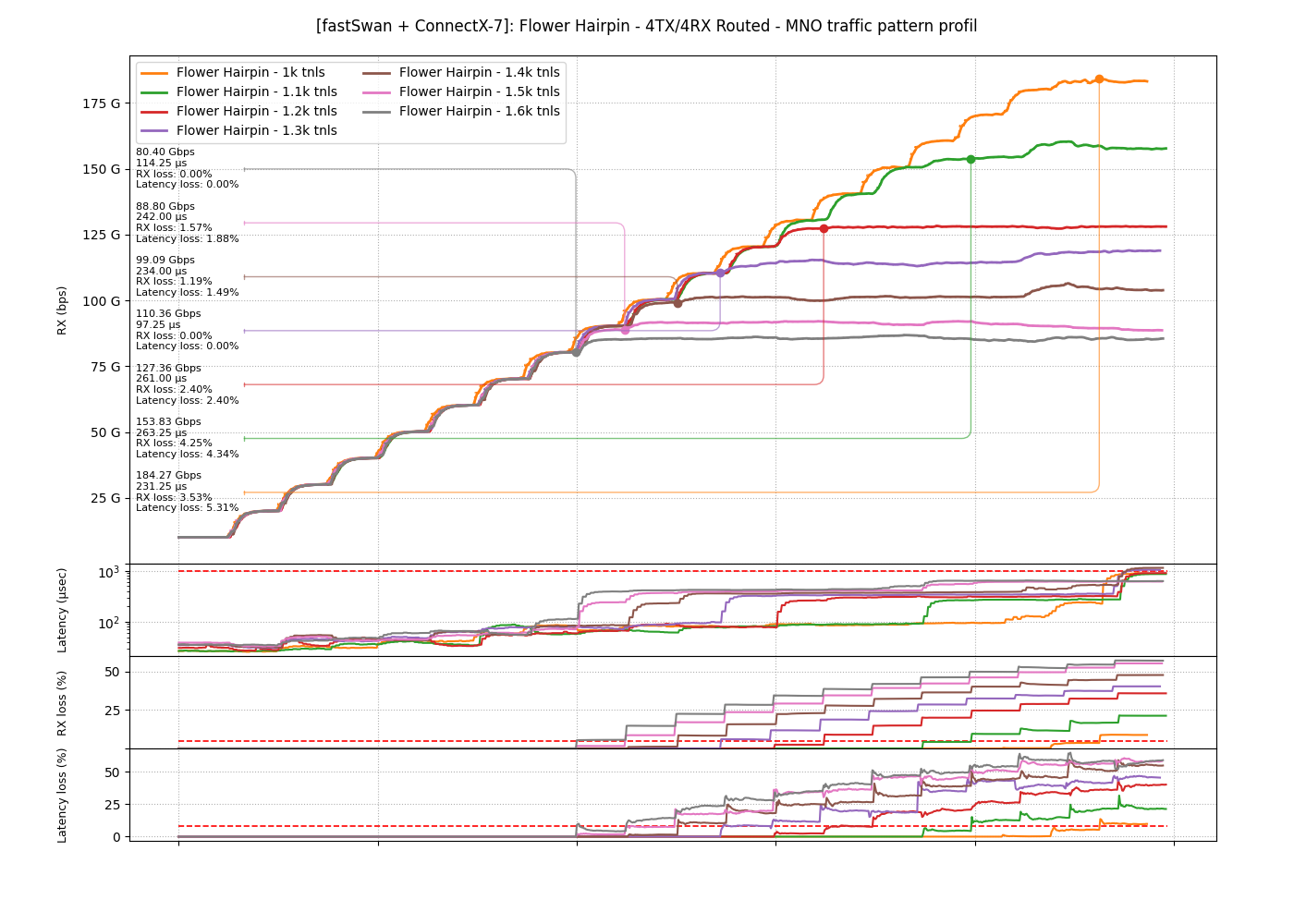
Flower starts close to XDP at 1k with 184.3 Gbps, then falls faster as tunnels grow and reaches 80.4 Gbps at 1.6k. A point measured at 1.7k holds 78.7 Gbps, only 1.7 Gbps below 1.6k, so the curve settles toward a floor near 80 Gbps instead of collapsing.
XDP vs Flower performance analysis
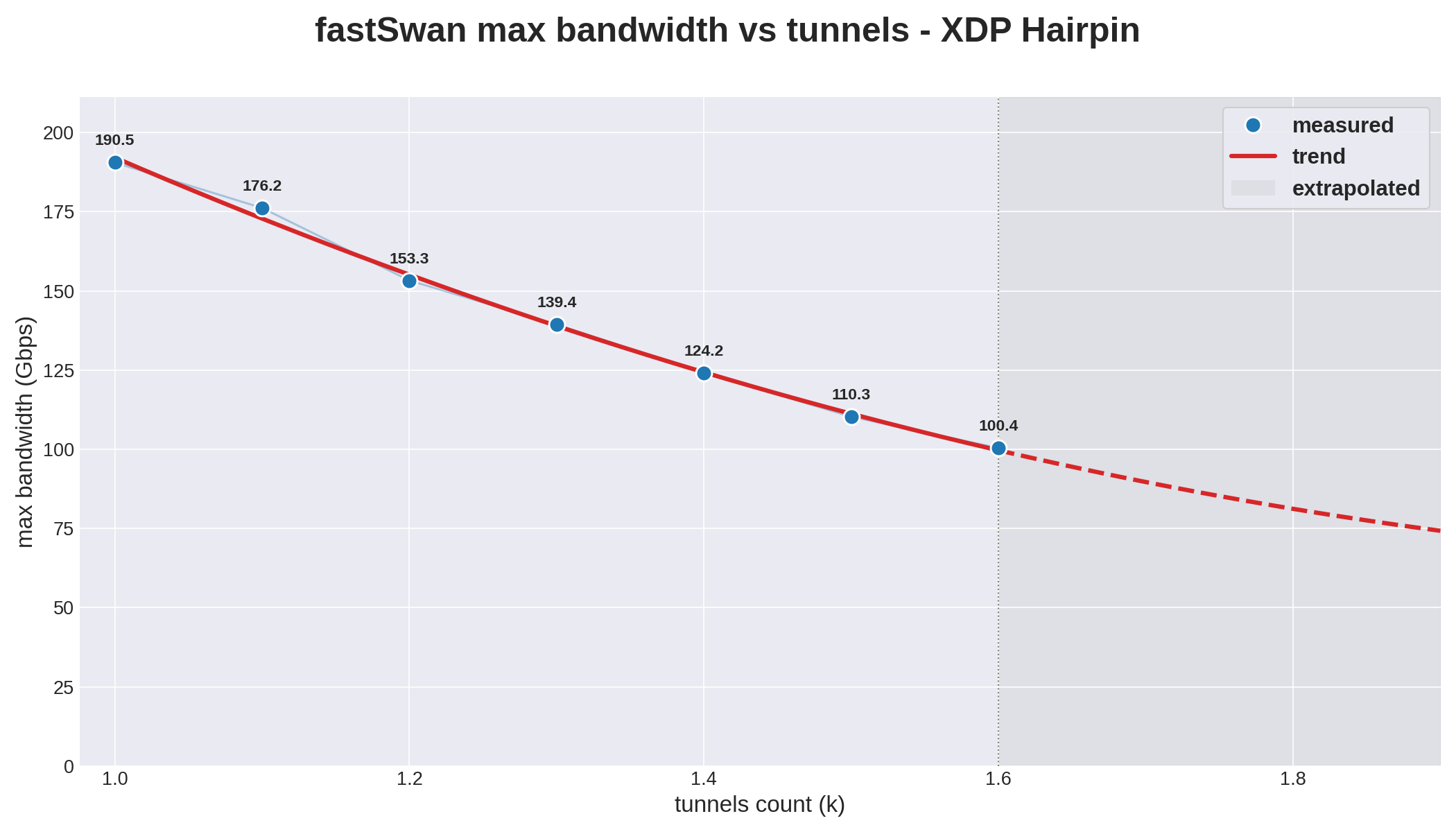
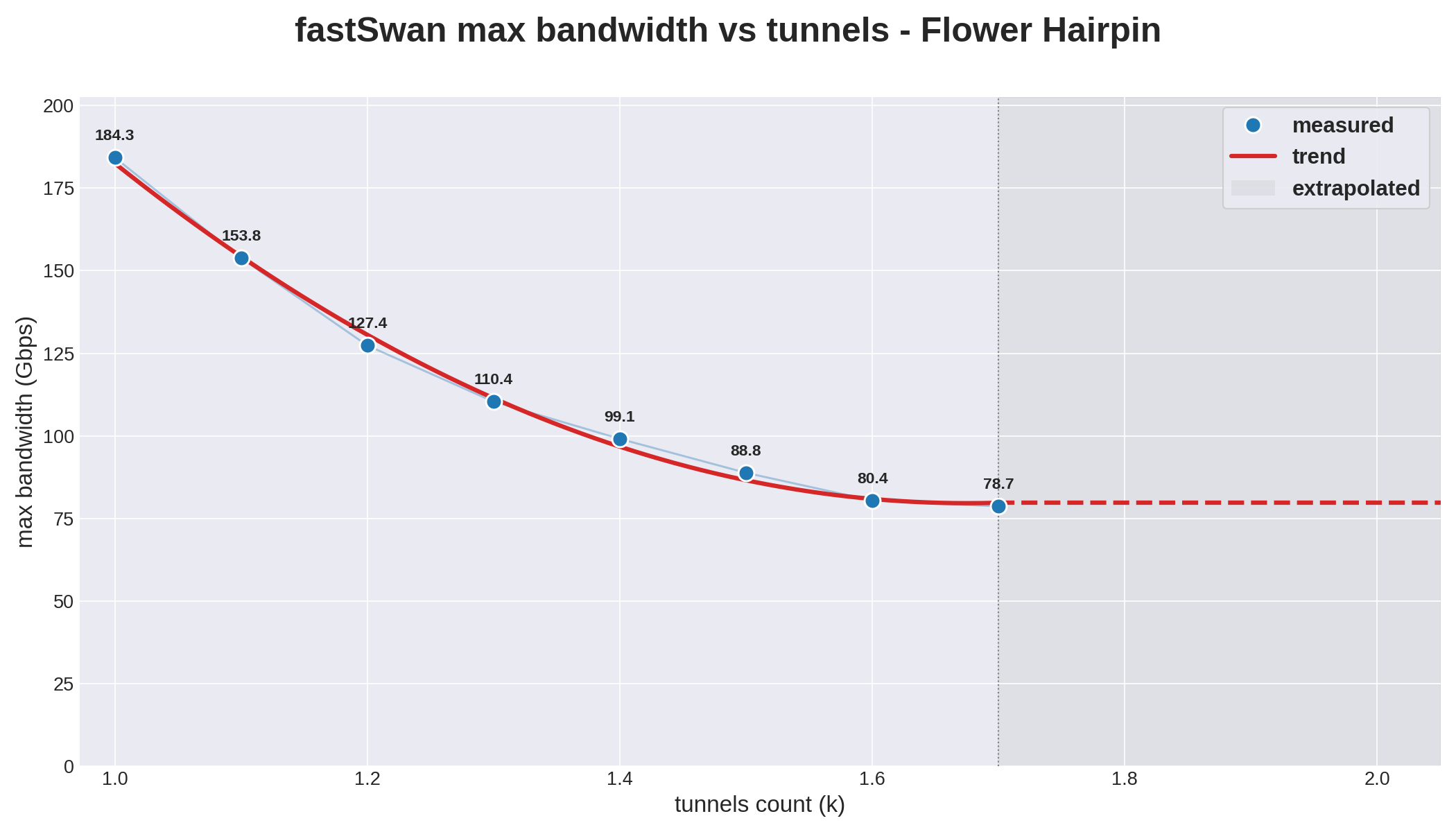
Both models lose throughput as the tunnel count climbs. The table lists the maximum each sustains before traffic drops.
| Tunnels (k) | XDP (Gbps) | Flower (Gbps) | XDP advantage |
|---|---|---|---|
| 1.0 | 190.5 | 184.3 | +6.2 (+3%) |
| 1.1 | 176.2 | 153.8 | +22.4 (+15%) |
| 1.2 | 153.3 | 127.4 | +25.9 (+20%) |
| 1.3 | 139.4 | 110.4 | +29.0 (+26%) |
| 1.4 | 124.2 | 99.1 | +25.1 (+25%) |
| 1.5 | 110.3 | 88.8 | +21.5 (+24%) |
| 1.6 | 100.4 | 80.4 | +20.0 (+25%) |
At 1k the two nearly match, with XDP ahead by 3 %. The gap widens fast and holds near 25 % from 1.3k on. Averaged over the sweep XDP sustains 142 Gbps against 121, about 18 % more headroom.
The two shapes differ. XDP falls almost linearly, about 150 Gbps per extra 1k tunnels, while Flower drops faster early then flattens near 80 Gbps.
XDP stays at or above 100 Gbps throughout, while Flower drops below it by 1.4k. The likely cause is flower hardware steering, which pays a rising per-flow cost as tunnels grow, while XDP absorbs it more gently.
XDP vs Flower overall
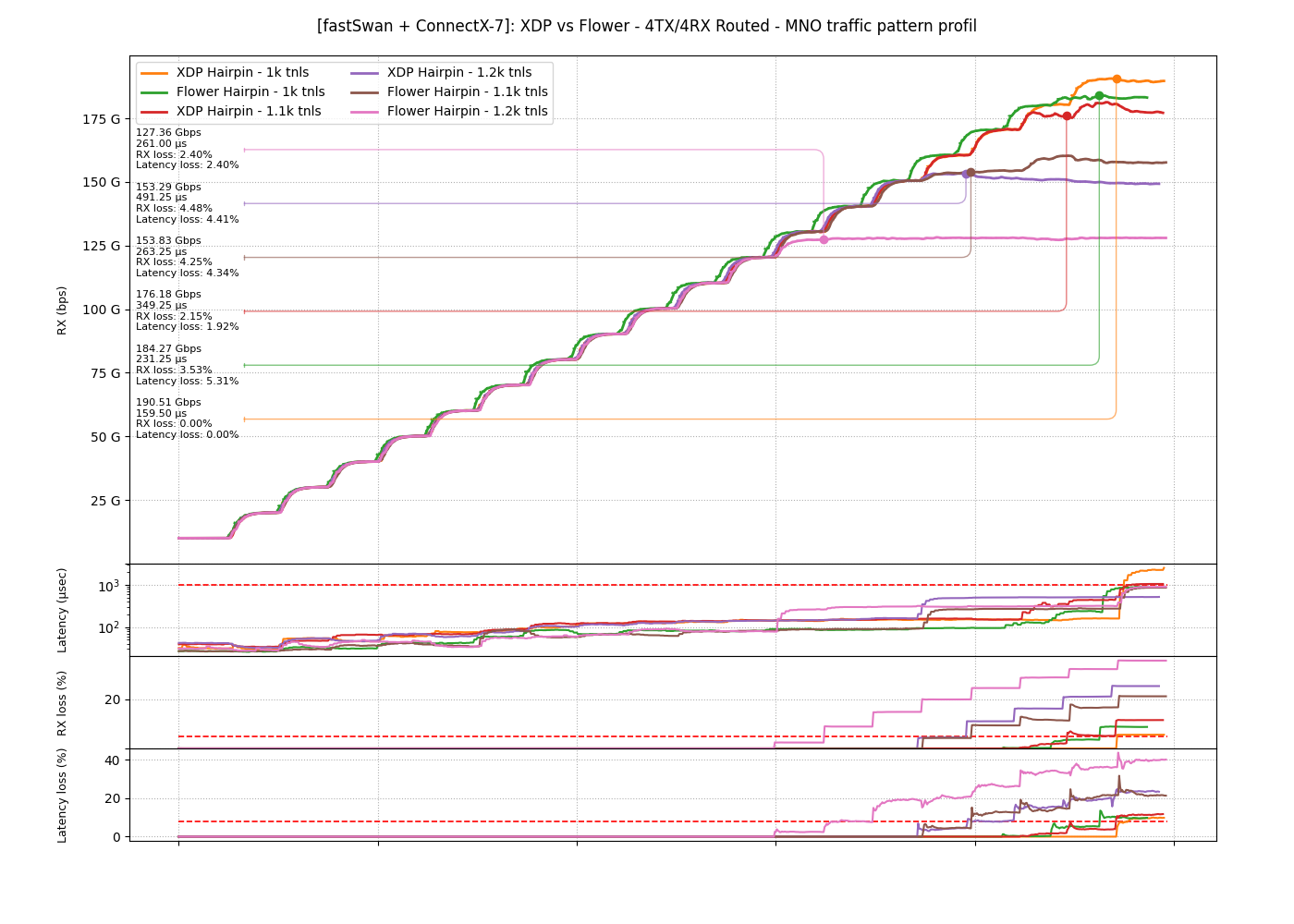
The last graph overlays both models at 1k, 1.1k and 1.2k on one TRex view. At 1k Flower sits right in the performance range and wins on latency, which is exactly where it belongs. One step up the picture turns, since Flower bandwidth falls away quickly while XDP barely moves. Flower buys lower latency when the load fits, and gives up throughput headroom in return.
Cross-port topology consideration
Splitting clear-text on one port and IPsec on the other is exactly the use case switchdev is built for, and NIC mode hits two structural walls:
- HW side: cross-port redirect does not work out of the box with the stock mlx5 driver in NIC mode, and making it work would take significant kernel effort. That effort is a waste, since switchdev is exactly the path designed for vport-to-vport forwarding. In NIC mode the answer is to stay on same-port hairpinning.
- XDP side:
mlx5e_xdp_xmitpicks the target XDPSQ bysmp_processor_id()and silently drops postchannels.num. Working around it (24 channels per port, RSS restricted viaethtool -X equal 10) reaches the same bandwidth as same-port hairpin but at 90 % CPU on every dataplane CPU.
Conclusion
At low tunnel counts the CX7 with IPsec packet offload reaches its wire
ceiling, about 97 Gbps per port under ipsec-cx7 and 98.2 Gbps under
the realistic MNO-traffic-pattern profile. That ceiling fades as the
tunnel count grows, since the NIC and PCIe steering path, not the host
CPU, becomes the limit.
The tradeoff is clear. XDP keeps the higher throughput and degrades gently, holding at or above 100 Gbps aggregate through 1.6k tunnels, while Flower trades that headroom for 0 % CPU and lower latency where the load fits. On a mobile network, where latency matters most, that points to flower.
The numbers carry one caveat. The bench loads every tunnel uniformly, the worst case for steering cost, while real mobile traffic is not. With the usual over-subscription for eNodeB or gNodeB IPsec, the per-tunnel ceilings here leave comfortable margin.
That split hints at a path the bench does not walk. A hybrid could let flower carry the established tunnels in hardware at 0 % CPU, while XDP on the host picks up the new ones as they come up, taking flower's efficiency and XDP's headroom at once. Building it is left here as an exercise, or a contribution.